When I was a younger surgeon, I was obsessed with efficiency. That translated in its most simple form to being fast. I wanted to get cases done and do as much as I could possibly squeeze into a day.
The OR promotes this activity. Everyone praises you for being able to do cases quickly. Productivity, no matter what the quality, is seen as a good thing. I’m sure that, along the way, some of my earlier failures as a surgeon related to this effort to be fast and efficient.
Even worse than promoting fast, the OR tends to punish slow. There is nothing wrong with being deliberate. We have to progress in the OR. We need to get things done, so we can’t be too slow, but it’s important to remember that not everyone works at the same pace.
When I hear OR staffers complain about colleagues being “slow,” I always add a comment like, “You should see how good their X-rays are.” This support is especially important for our newer colleagues who are just starting their surgical practices. They need grace to build and develop their skills as safe surgeons!
At some point in my career, I noticed myself always asking for things ‘real fast’ during cases. “Can I get that rongeur real fast?” or “Can I just see that freer real fast?” I wanted everything ‘real fast.’
This didn’t mean just doing unacceptable work. I certainly found myself in cases that didn’t go so fast. When I think about it, that thought process of going fast probably led to inefficiency. The push for a frenetic pace leads to mistakes that ultimately slow us down.
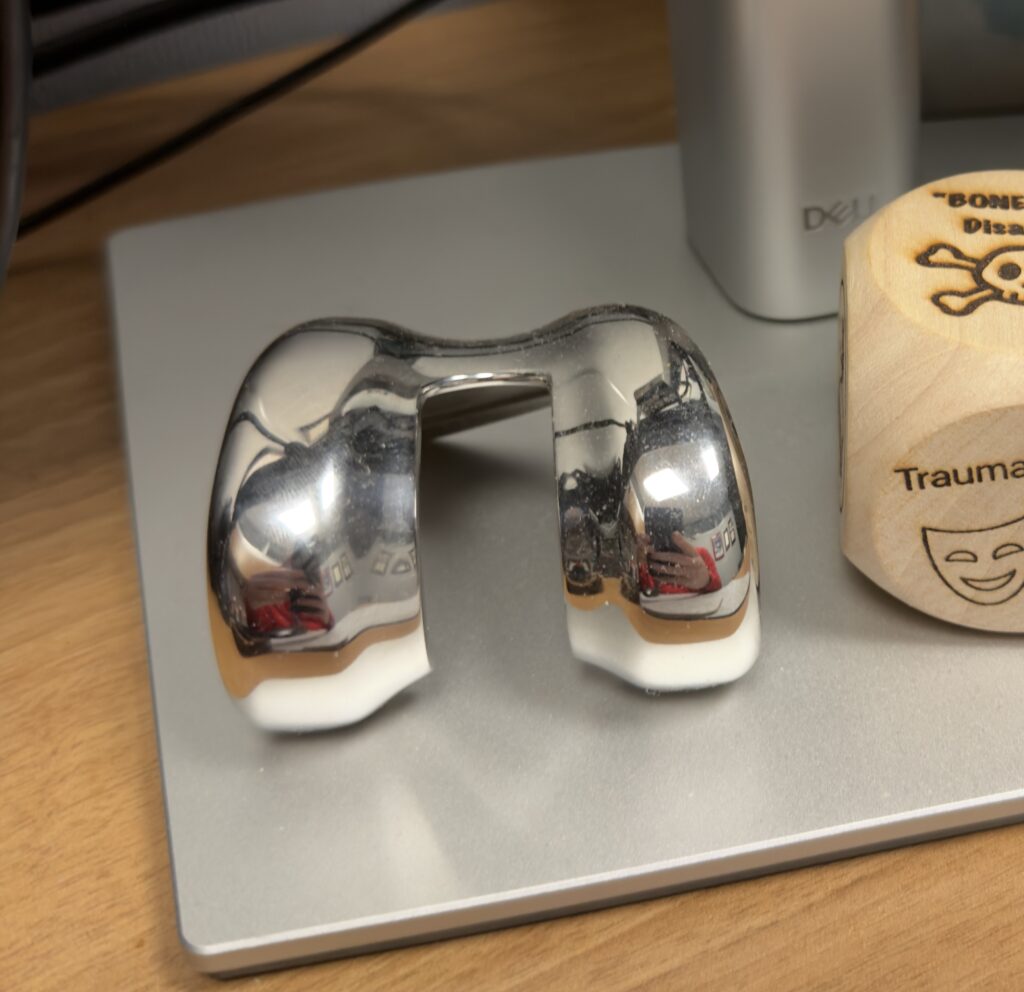
I have a total knee femoral component sitting on my desk. One day, I was working on a case, and we weren’t moving as quickly as I wanted us to. I decided to go and “help” open the implants so the scrub tech could get the cement ready.
In my rush to “help,” the femoral component slipped out of my hands and ended up on the floor. The rep didn’t have another femoral component in the hall, so they had to go to the basement to get the replacement. My push to make us more efficient led to a 15-minute delay.
The implant sits on my desk as a reminder that you can go too fast!
I don’t want the message to be incorrectly heard here. It’s appropriate to seek out efficiency. It’s great to figure out how to do more cases in a day. We have to not just automatically think that if we speed everyone around us up, that will translate.
“Slow is fast.”
When I was in training, I worked with a hand surgeon who never wasted a move. Throughout his career, he had refined his movements to make everything mean something. He never rushed anyone. He never asked for things quickly. Our every move was scrutinized and corrected (gently) under loupe magnification.
In my current practice, I make an effort to slow everyone around me down. I’m not talking about getting in people’s way or sabotaging progress. I’m talking about the pace of everyone around me. Slow talking. If the scrub is rushing to find something or pass instruments, give them an indication that it’s ok not to rush.
When the residents ask for instruments “real fast,” I just give them some reassurance that it’s ok to take our time and do it right at the first go. Or, maybe jokingly ask, “Why are you trying to go so fast, Ricky Bobby?” (Assuming they get my increasingly outdated move references.)

Life moves too fast as it is. Slow down a little. Take the time that is appropriate to do the job well on the first go. Your patients will appreciate you, your staff and colleagues will appreciate you, and maybe, you’ll be able to take the time to appreciate what an amazing job we have.