Let’s Talk About Walking

As I mentioned in my last post, walking has been the cornerstone of my journey toward a healthier life. But honestly? It’s provided so much more than just physical results.

Walking has become my “me time.” It’s when I catch up on audiobooks and podcasts, or use the hands-free time to call mentors, colleagues, and friends.

Most importantly, my walks serve as a sanctuary for reflection and brainstorming—a true mental gym. Inspiration often hits me in the middle of a beautiful morning or while admiring a neighbor’s landscaping. In those moments, I find I don’t want any distractions at all; I just want to think.

The Numbers: A Seven-Month Deep Dive

I’m often asked just how much I’ve actually walked since I started this journey in May 2025. When I sat down to look at the data from May through December, even I was surprised:

  • Total Distance: 1,422 miles
  • Total Time: ~450 hours
  • The Big Picture: I spent nearly 19 full days of 2025 just walking.

At an average pace of 19 minutes per mile, it’s a massive investment of time. But looking back? Every single minute was worth it. I love it when people around town or at the office tell me, “I think I saw you out walking the other day!”

Finding the Balance

I’ve reached a point where if the weather is miserable or a meeting runs long and I miss my walk, I feel like something is missing.

However, I’ve had to work on maintaining a healthy relationship with the habit. I’ve come to realize that if I need to skip a day for family or a pressing work deadline, that is okay. Life happens. I do what I need to do, let go of the guilt, and get back to the pavement the next day.

Making it Work (Even When it’s Boring)

I do have a treadmill at home, but I’ll be honest: my brain loses interest after about 3 miles of staring at a wall. To get through indoor sessions, I watch a basketball or football game while I’m walking. It keeps me from obsessing over the fact that I’m walking in place!

My Advice: Just Start

Wherever and however you do it, I highly recommend finding time to move. It’s not about breaking world records; it’s about the fact that motion keeps us alive. It spurs creativity, stabilizes your mood, and (when the sun is actually out) gives you a much-needed Vitamin D boost.

From a fitness perspective, remember: all movement requires energy. Every step gets you further along your journey.

Start small. Walk a half-mile. Spend five minutes of your lunch break circling the building. You’ll notice the benefits almost immediately—and I promise, it will eventually become the part of the day you look forward to most.
Physician, Heal Thyself – My Weight Loss Journey and 2026 New Year’s Resolution

As we enter 2026, I want to talk about a significant life update for me.

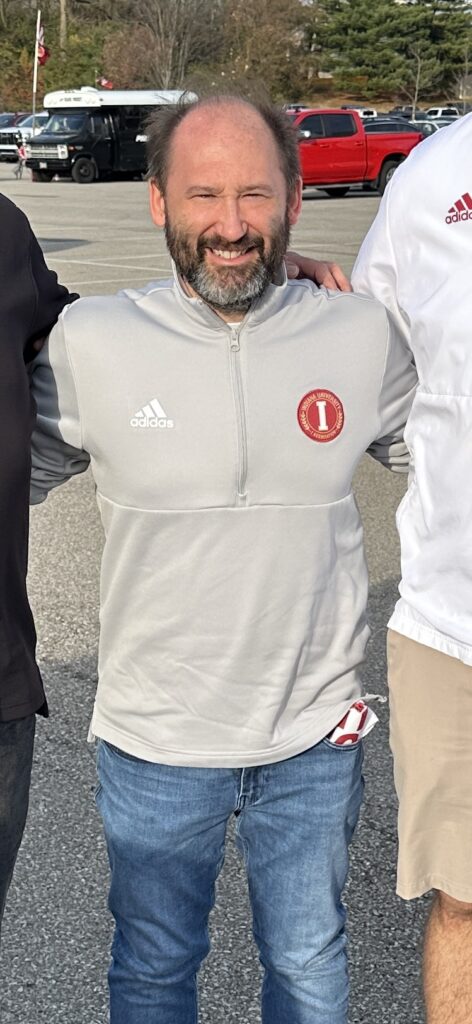
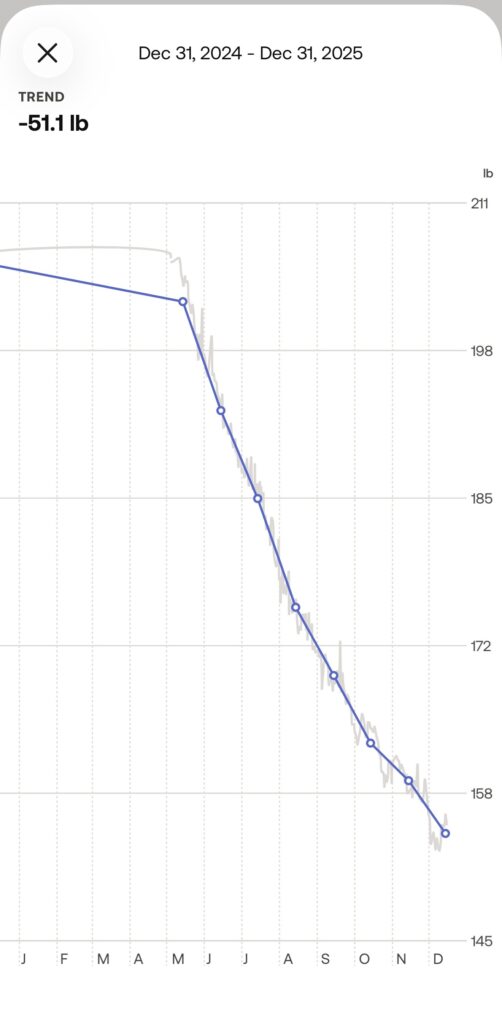
In May 2025, I weighed 206 pounds. I was overweight. I didn’t feel good. I wasn’t being productive. How did I get there?

I got lazy!

I got up in the morning, and I went to work. I did my job. Then, I came home and took a nap. After my glorious nap, I ate some food, and then I spent time on the couch watching TV and scrolling social media. I went to bed and woke up the next day to do not very much all over again.

Oh yeah, when I was at work, I ate everything I could get my hands on. Chocolate. Candy. Ice cream. It tastes good. I was working hard. I deserved it.

When my clothes didn’t fit, I just got bigger scrubs or bought new pants or quarter-zips (my uniform…). I bought a new suit because the old one was way too small.

Let’s talk about my stats. I was 206.7 pounds. I was at 30.5% body fat. My BMI was 33.4. My Hgb A1c was 5.7%. I was hypertensive. My systolic blood pressure was in the high 130s or 140s.

I didn’t feel healthy. I didn’t look healthy. I needed to make a change.

I started my change with Noom. (Not an ad.) I like Noom because it addresses obesity from a multi-pronged approach. I’m a data person. I like to have information to reinforce progress. Charts are helpful to me.

In addition to the data, their cognitive behavioral therapy (CBT) approach is great. The lessons are short and easy to understand. They help with some of the food noise and the desire to eat everything in sight (my inner elephant).

Food tracking is very helpful as well. Calories stack up on us when we aren’t paying attention. What’s one fist full of candy anyway? They’re small pieces!

Those small pieces add up quickly.

It’s time to answer everyone’s question who has made it this far.

Did you do it with medicine?

The answer: I did it with the help of medicine.

I am taking semaglutide. I find that it helps keep me from eating a donut and the candy in the office, and from getting some caramels at the gift shop between cases. I feel full faster, so I eat less and I eat less often.

I don’t attribute my weight loss soley to a medication. In addition to everything above, I got off the couch and out of bed and started walking. Every. Day. Rain or shine. During COVID, like the rest of the world, I bought a treadmill, so sometimes I walk inside if the weather is too nasty.

I walk about 6 miles every day. Some days, if I’m not being very active, I will go for 7 or maybe 8. If I’ve been in the OR all day, I might just go 3 or 4. I have had a couple day where I couldn’t get a walk in. (That’s OK!) Since May, I’ve walked just over 1,400 miles!

About halfway through, I hit a wall and was having trouble getting weight off. When that happened, I started weightlifting. I lift two days per week. One day is an upper-body workout, and the second is a lower-body workout. (I still walk on days I lift as well.)

Did I turn vegetarian? Only eat dry chicken and rice? No. I really didn’t change what I eat. I only changed how much and, with some foods, how frequently I eat them. I still have some chocolate every now and then. I’ll still get dessert if we go out to eat. Instead of eating a whole piece of cake, I have a few bites. I satisfy my sweet tooth and don’t go too many calories over for the day!

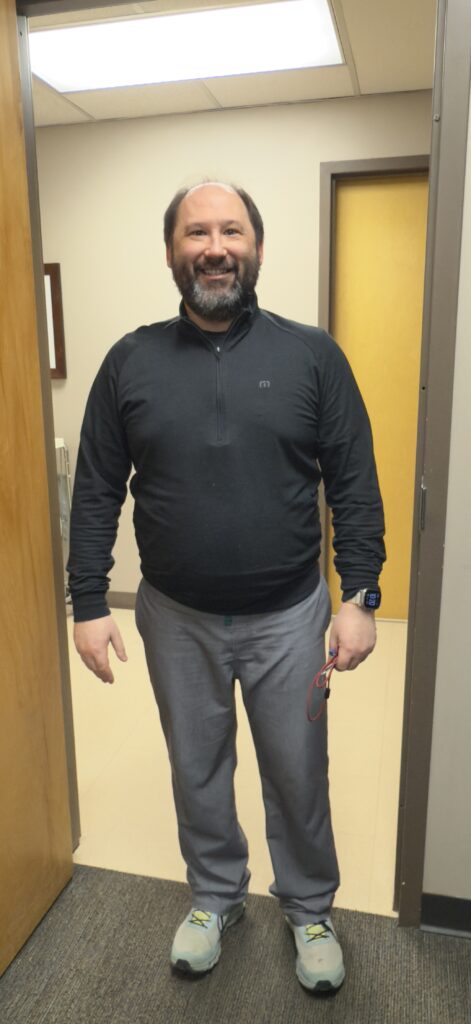
So, where am I today? I am at 151 pounds. My body fat percentage is 15%. My Hgb A1c in November was 5.3%, and it’s likely lower now. My blood pressure has normalized.

Screenshot

I feel better. I look better.

I am still moving. I don’t walk 6 miles every day, but I get at least 3 in. I am lifting weights two times per week. I am adding some daily push-ups and planks to continue burning calories and help grow more muscle.

As we enter 2026, my New Year’s resolution is not to change, but to keep my newly formed habits. I don’t plan to give up my daily walks because I find that they help me in more ways than improving my physical health. I’ll save that conversation for another blog post in the near future.

I was able to use a lot of resources. If you don’t want to take a medication, my recommendation is just go outside and walk. Do it whenever you can. If you can’t walk for 6 miles, walk 2 or 3. Start with a half mile or one. Work your way up over time.

You also need some accountabilty to pay attention to how you are doing. I weighed myself every day. You don’t have to weigh in every day if you don’t want to. Weigh in once a week or every few days. I made it part of my morning routine. Shower, brush teeth, weigh myself, go on about my day. For me, weighing in at the beginnning of the day put some focus on the goal and kept me motivated to keep moving..

In my opinion, it isn’t helpful to apply a timeline to your weight loss. Life will get in your way. Weight will go up and down. Something will happen that requires you to focus on that instead of weight loss. If you get stuck or stop, just start again the next day.

Good luck to all of you who are working on a more halthy weight and here’s to a happy and healthy 2026!

“Real Fast”

When I was a younger surgeon, I was obsessed with efficiency. That translated in its most simple form to being fast. I wanted to get cases done and do as much as I could possibly squeeze into a day.

The OR promotes this activity. Everyone praises you for being able to do cases quickly. Productivity, no matter what the quality, is seen as a good thing. I’m sure that, along the way, some of my earlier failures as a surgeon related to this effort to be fast and efficient.

Even worse than promoting fast, the OR tends to punish slow. There is nothing wrong with being deliberate. We have to progress in the OR. We need to get things done, so we can’t be too slow, but it’s important to remember that not everyone works at the same pace.

When I hear OR staffers complain about colleagues being “slow,” I always add a comment like, “You should see how good their X-rays are.” This support is especially important for our newer colleagues who are just starting their surgical practices. They need grace to build and develop their skills as safe surgeons!

At some point in my career, I noticed myself always asking for things ‘real fast’ during cases. “Can I get that rongeur real fast?” or “Can I just see that freer real fast?” I wanted everything ‘real fast.’

This didn’t mean just doing unacceptable work. I certainly found myself in cases that didn’t go so fast. When I think about it, that thought process of going fast probably led to inefficiency. The push for a frenetic pace leads to mistakes that ultimately slow us down.

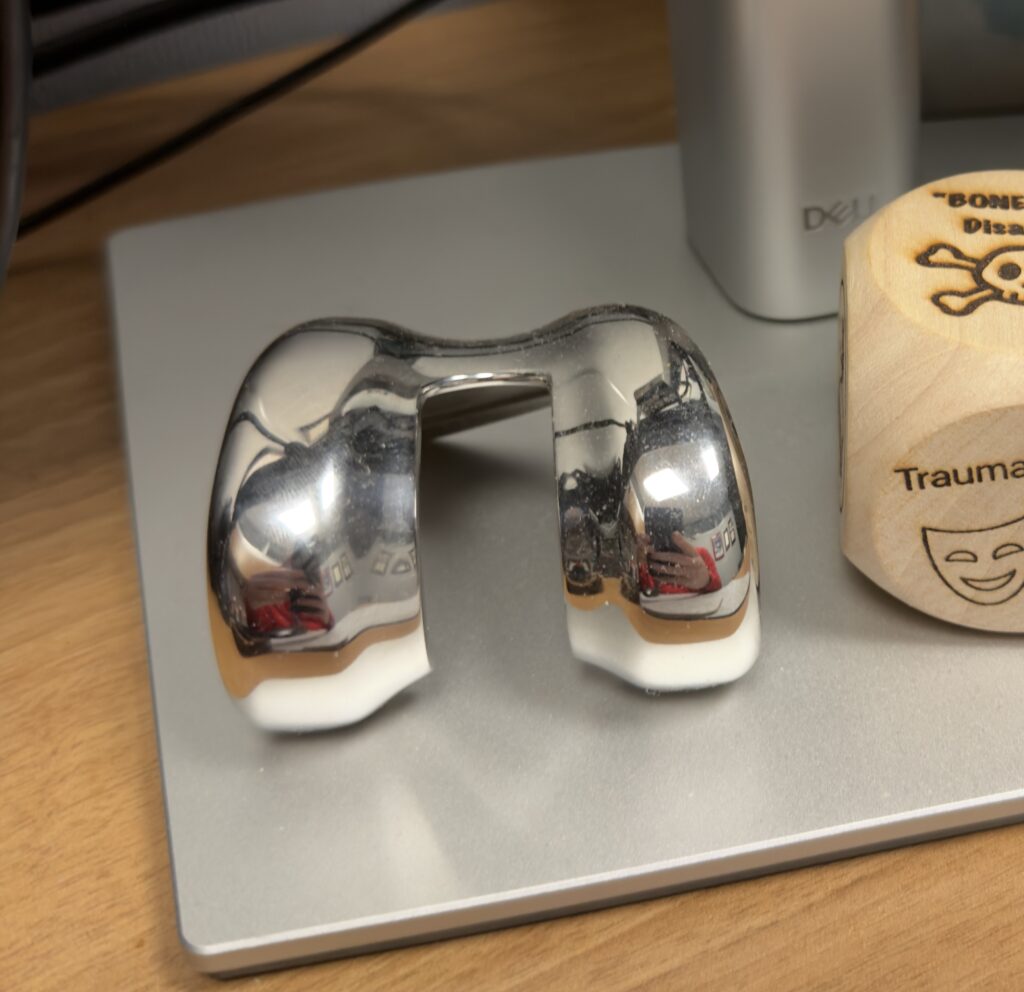
I have a total knee femoral component sitting on my desk. One day, I was working on a case, and we weren’t moving as quickly as I wanted us to. I decided to go and “help” open the implants so the scrub tech could get the cement ready.

In my rush to “help,” the femoral component slipped out of my hands and ended up on the floor. The rep didn’t have another femoral component in the hall, so they had to go to the basement to get the replacement. My push to make us more efficient led to a 15-minute delay.

The implant sits on my desk as a reminder that you can go too fast!

I don’t want the message to be incorrectly heard here. It’s appropriate to seek out efficiency. It’s great to figure out how to do more cases in a day. We have to not just automatically think that if we speed everyone around us up, that will translate.

“Slow is fast.”

When I was in training, I worked with a hand surgeon who never wasted a move. Throughout his career, he had refined his movements to make everything mean something. He never rushed anyone. He never asked for things quickly. Our every move was scrutinized and corrected (gently) under loupe magnification.

In my current practice, I make an effort to slow everyone around me down. I’m not talking about getting in people’s way or sabotaging progress. I’m talking about the pace of everyone around me. Slow talking. If the scrub is rushing to find something or pass instruments, give them an indication that it’s ok not to rush.

When the residents ask for instruments “real fast,” I just give them some reassurance that it’s ok to take our time and do it right at the first go. Or, maybe jokingly ask, “Why are you trying to go so fast, Ricky Bobby?” (Assuming they get my increasingly outdated move references.)

Life moves too fast as it is. Slow down a little. Take the time that is appropriate to do the job well on the first go. Your patients will appreciate you, your staff and colleagues will appreciate you, and maybe, you’ll be able to take the time to appreciate what an amazing job we have.

How to Excel in an Orthopaedic Surgery Sub-Internship, v 2.0

Orthopaedic surgery residency has never been more competitive. If you look at the statistics, matching can be a little more than a coin toss. Given that, when you get an opportunity to work with residents and faculty one-on-one, it is crucial not to waste that time.

It’s essential to understand who is usually on a residency selection committee. The committee is composed of representative faculty as well as residents. (If a program doesn’t have residents on their selection committee, you don’t want to go there.) It’s important to remember that you aren’t just doing an audition rotation to impress a faculty member and get a recommendation letter. The residents have a significant say in who they want to work with when a new class joins. A program may altogether remove a student from their rank list after resident feedback.

Don’t underestimate other people in the program. The residency program coordinator and the medical student coordinator (if a program has one) are essential. Same for PAs and NPs, nurses (in the office and on the floors), secretaries, and assistants. Be nice to the janitors! Treat everyone like they are your grandmother. If you are rude to them or don’t complete a task on time, that is likely to get communicated back to the program selection committee, and the result can be not being included on a rank list when the time comes. I know it seems like something that shouldn’t have to be said, but it happens way more than it should.

I’m not writing this to cause fear. You shouldn’t spend too much time walking around on pins and needles. Be the normal person you already are, and things will go well. Here are some more thoughts that I have about excelling on an orthopaedic rotation.

Before you go do your rotation, do some research on the place. Who are the people? Who is the chair? Who is the program director? Does the residency website say who the administrative chief resident is? Who is the coordinator? What attendings are you going to work with? Where do they come from? Do you have something in common with someone at this program? Use that to your advantage when you get there.

Make sure you have done some prep work before going into the operating room. Talk with the chief resident on the service or the attending and see if you can get a sense for what you will be doing the following day. Sometimes this is hard, for example, in a really busy Trauma service, but if you do a little bit of legwork ahead of time, it will help you be more prepared.

Get to know the patients. Talk to them. Introduce yourself to them. Round on them before and after cases so that you can learn about their injury and their recovery. Taking ownership of patients as a medical student will show that you are going to take ownership of the patients as a resident and will be a good team member and caring physician.

Show up to the operating room early. Introduce yourself to everyone in the room. Write your name on the board so the nurse can put you in the computer. Write your glove sizes on the board as well. Never assume someone will get your gloves. Grab gloves and a gown for the first case and ask the scrub if they want you to flip them onto the field or give them to someone else to put them on the field. Don’t be surprised if they don’t want you to put something on their sterile field until they trust you to do it correctly.


When the patient gets into the room, help the team. Don’t stand in the corner and watch. Get in on the action. You may not be invited up to the table. The focus is on the patient at that point, not other people in the room. Go and grab a warm blanket for the patient. Help move the patient to the OR table (not the feet). Get in there and do the heavy lifting. Help turn the patient. Don’t throw stuff on the floor that one of the room staff is just going to have to come behind you and pick up later. If you show you have their back, they will get yours!


When it’s time to prep the patient, ask if you can help. The person prepping the patient may or may not need it. Again, make yourself part of the team. Everyone in the room is focused on getting the case started and may not be looking around to invite people to help.


Prepare for cases. Ask the resident or attending that you are working with to go over cases the day before. The resident may be able to prep you for questions. Read up on the anatomy. You aren’t expected by most people to know much more than that.


When you are asked a question during a case or on rounds/in the office, don’t panic. The purpose of the question may not be to see whether or not you know the answer. It may be to evaluate your thought process. Can you work your way to the solution? I worked a lot with a faculty member as a student where I ended up doing my residency. He loved to ask me questions about musical artists. I almost never knew the answer. It became a fun game. No one was keeping score as to which answers I got right or wrong. Usually, by the way, no one is.


Practice knot tying and suturing at home. Be able to tie one-handed and two-handed. Practicing using your dominant and non-dominant hand. Learn to use scissors and clamps with both hands. If you have practiced when someone asks you to do something and you can do it efficiently, you will be asked to help more and more. If you aren’t sure, ask the scrub to show you how to hold an instrument or use it correctly. They will show you.


Have supplies with you that will be helpful. Keep a pen (that you don’t like too much) in your pocket. Have trauma sheers available. Help with dressing changes in the mornings. If you can work ahead of the resident or attending, you will be seen as a valuable team member.


Be prepared to show up early and work late. This is the same thing a person would do if they got an entry-level job in the business world and wanted to work their way up the ladder.


At the end of the day, just like the residents and faculty are trying to decide whether you might be a good fit for their program, you should be doing the same thing. Try to talk to as many residents as you can. Get a sense of what their life is like. Are they miserable? Is it just that they are on a particularly busy and challenging rotation, or is every rotation at a program miserable and difficult? Get a sense from the faculty whether or not they enjoy their job. If the faculty are miserable, there’s a good chance the residents aren’t going to be much happier. Talk to PAs and NPs if you are helping them close. They can give you useful information about the program.

There are more applicants than spots. Except for a few people, almost everyone is mashed up pretty close together. Applications are surprisingly similar, with similar-sounding letters of recommendation and personal statements. Everyone has good clinical grades and an acceptable test score.

The best way to distinguish one applicant from another is to see their work-ethic in person.

Why Do Physicians Have to Be Leaders?

“Why can’t I just work here?” is a question that many physicians may ask at the end of a long day. There are many tasks to be completed. There is a never-ending supply of work to be done. On top of that, no matter how much work we get done, it seems like there is always the demand to do more. It eventually becomes exhausting.

To be even more practical, there are patients who are depending on us. These are people who WANT and NEED to get better so that they can go about their daily lives. They need to go to the operating room so that they can recover from their injury. They need their medications to lower their blood pressure or better control their diabetes before something terrible and irreversible happens to them. They need their cancer treatments to prevent metastatic spread and an irreversible outcome.

Similar to what I discussed here, it isn’t hard to get ‘stuck in the suck.’

If we want to make things better. If we want to help our colleagues and our patients, it isn’t enough to just work here. We have to be willing to look critically at what we do on a daily basis. We have to be willing to look for solutions to make it better. We have to be willing to come to the table and discuss these issues with the people in charge. Sometimes, we have to be willing to drag the leaders to the table to explain to them why things aren’t going well.

And….

We have to be willing to do it the right way. Attitude matters, much as we don’t want it to. We can be disappointed. We can even be angry when things don’t go as we would expect them to. BUT, you have to be angry and disappointed in the right way. You have to attack the correct enemy. It isn’t the administrators. It isn’t the patient. It isn’t the charge nurse. It isn’t the scrub tech. It isn’t a student or a resident or a fellow. It isn’t even YOU! Be mad at situations, at the inequalities that our patients face. Understand and point out the fact that we’re all in this together, and, sometimes, despite everyone’s best efforts, we all miss the mark.

Here’s the most important thing that we all need to be reminded of. We’re humans taking care of humans. There aren’t any robots involved. There aren’t any gods involved. Everyone is fallible. Perfection is the goal, but it will rarely, if ever, be obtained.

So, control what you can control. Own what you are an expert in. Don’t settle for doing it wrong or something that harms patient care.

HOWEVER, and this is important….

You can’t be a jerk and then claim doing so in the name of better patient care! You still need to be respectful.

Say “hello” to your colleagues in the hallways. Learn who you work with. Who are they when they leave the hospital or the clinic? Fostering these relationships will help to create the psychological safety necessary to allow everyone to speak up. You’d be surprised where the solutions to problems will come from. Give everyone a voice. If a person’s voice isn’t being heard, take them with you to the forum where people can listen.

Ask for help. Find the experts in whatever the problem might be. Just like we are supposed to seek out disease, seek out solutions! If you try something and it doesn’t work, regroup and try something different.

I saw something bemoaning QI work and calling it worthless. If you do the right QI work, it isn’t worthless. We should be working on QI every single day. If we want to help our patients, we have to lead the way.

10 Commandments of Orthopaedic Surgery

According to Ryan K Harrison….

(In no particular order)

-Don’t ignore pain out of proportion to your exam

-Don’t varus.

-When you can’t see the skin, you’ve applied enough padding.

-When the nurse asks you to come and see the patient, just go.

-Touch every bone and move every joint, you’ll never miss anything.

-Don’t get fooled by X-rays

-Never Discharge a prisoner or homeless patient with an injury that needs surgery.

-Just because you’re having a bad day doesn’t mean everyone else has to.

-If you’re wondering if it’s sterile, it isn’t. Redo it.

-The amount of time you spend preparing before you walk into the operating room will be inversely proportion to the amount of time you waste inside the operating room.

Welcome to the first day of the rest of your life!

You spent 13 years in K-12, four years as an undergraduate student, and four years in medical school, plus/minus whatever other education or sidequests you may have been on.  You survived writing a personal statement and going through interviews, creating a rank list, and the age-old ritual of opening that envelope to find out where you will undergo residency training. 

It’s July 1. It’s the first day of residency training. 

The first day is overwhelming. There is no way to soften the blow. It doesn’t matter how prepared you are, what medical school you went to, what specialty you chose. The first order will trigger the imposter syndrome everyone worries about.

First and foremost, you must remember that YOU ARE NOT ALONE. Medicine is a team sport. Even ten years into practice, I regularly discuss patients and cases with my colleagues and mentors. There is never any reason to try and impress people by proving you can figure it out without help. The balance of medical knowledge and the rate with which we learn new things is too outstanding for any human to know everything there is to know about medicine. Knowing what you don’t know is infinitely more important than any fact you can learn.

For proceduralists, there is more to it than knowing the limits of your knowledge. You must also understand the limits of your skills. At first, all of the procedures are new. You read about the steps. You learn the relevant anatomy. Then, you watch. Then, you perform while supervised. Finally, you will be able to perform a procedure independently. 

Remember, a patient is on the other end of whatever procedure needs to be performed. Procedures almost always have the capacity to cause the patient pain. There are potential complications. Treat pain. Be honest with patients about what you need to do to help them get better and what can possibly go wrong. Use words the patient can understand. Patients appreciate doctors who communicate with them and are humans instead of robots.

Take a little time to learn something about your patients beyond what is written in their H&P or daily progress notes. Get to know who makes up their family, what they do for work, and where they go to school. What hobbies or sports do they enjoy? Do they enjoy traveling or seeking out good food? Again, a human connection will go a million miles when you reach a difficult point in a patient’s care or encounter a complication that needs to be managed.

The patients are important, but to take great care of them, you need to be organized. There are many different methods. Perhaps you learned some while a student. Someone may have explained a good method during orientation or shadowing before the beginning of residency. Maybe you don’t have a suitable method. Make this a priority. Find a system before you finish reading this blog post. 

Are you all ready to make a list and check it twice? Now, it’s time to evaluate patients, determine a diagnosis, and develop a plan. You’ll come back later to ensure we implemented the proper plan and look for the results of your actions. 

This won’t always go as smoothly as you might think. Hospitals are complex places. There are many different hands involved in patient care. Tests require a patient (or perhaps some specimen collected from that patient) travel around the hospital. Orders have to be written and then acknowledged to be completed. A well-thought-out system is required to ensure the sometimes not-so-well-oiled machine does what it is supposed to.

Organization is not the only thing required to get this done. A bit (or maybe a lot) of tenacity is essential. Write an order and make sure it’s in. Connect with a nurse or a pharmacist to ensure the order was acknowledged. Double-check with a scheduling clerk that the procedure has a time. If the transporters can’t get the patient somewhere, sometimes you have to wheel the patient there yourself to make sure they are on time. In an emergency, you might have to insist someone get out of bed and drive to the hospital to provide the patient’s required care.

Again, these are times when you must remember that you are not alone. Taking care of patients will come with conflict. It is unavoidable. Responding to and mitigating conflict is a skill that takes time to learn. You will be right sometimes. You will probably be wrong more than you are correct at the beginning. Take a deep breath, listen to the other person, consider their knowledge and experiences, and react accordingly.  Assume the best of intentions. If you aren’t sure of the source of the conflict, ask some clarifying questions. Perhaps there is just a misunderstanding. Remember, everyone is there to make patients better. If you need to talk something out, don’t do it in front of patients!

If you aren’t sure of the best response, run the scenario past someone more senior. Discuss the issue and a strategy to respond. Don’t respond to scenarios when you are mad. If the conflict is being discussed over email, write your response and sleep on it. Have someone read over your response, and then send it. One of the best ways to defuse conflict is just simply to let time work its magic!

One final thought. (Yes, there could be so many more in a blog post like this!) You can’t take great care of patients unless you take care of yourself. You may hear people talk about spending a long day caring for patients and not taking time to eat, drink, or use the restroom. Do these essential functions. If you need five minutes to walk outside and get some air, TAKE IT! If you have an important phone call or need to talk with your significant other or a best friiend at an important moment, DO IT! 

There is always going to be work. There are always going to be patients. It is a never-ending stream. We all want to be great teammates and avoid passing work on to others. The reality is, you are probably never going to be able to hand off a clean slate. Look for the best transition points, and choose moments when you must stay until a task is completed wisely. There are some times when the extra time is important to you and your patient. You’ll figure those out as you go.

Remember, we call it practice for a reason. We’re all trying to be perfect.  Very few of us, if any of us, have made it there!

Good luck!

Don’t Drown in the Suck

When talking to students considering medicine as a career, I talk about all of the advantages or taking care of patients. I also say to everyone –

Remember, it is still a JOB.

Physicians are stuck in the middle these days. The expectations are high, and rightfully so. Our patients’ lives and livelihoods are on the line.

So, where is the suck? We have many bosses: our patients, our physician leaders, and our administrative leaders, not to mention the insurers. The insurers want to do everything but pay medical bills. The first goal of every insurance company is to maximize their profit – the complete opposite of the first goal of every physician.

Primum non Nocere!

It’s easy to want to give up. “I don’t get paid enough to deal with this,” may be a tempting out. In many ways, that is fair. Fighting everyone around us against the stream to provide appropriate care is not what we ever agreed to. Physicians are taught to say “yes,” and “how can we help.” If you want to be a successful physician, you HAVE to be available, able, AND affable. No one likes a cranky doctor, but it’s so hard to put on a fake smile when you leave the patient room and run into roadblocks and brick walls.

First and foremost. Take care of yourself. Ensure you have a solid plan to take care of your mind, body, and family. Use your paid vacation days – EVERY SINGLE ONE OF THEM – throughout the course of a year. We don’t get paid to work 365 days a year. Read something that isn’t a textbook or a journal. Take some time out of every day for a workout or some meditation. Spend some time every day with your family and friends or your pets.

What can we do at work to prevent drowning in the suck?

Get right in the middle of it! Get involved in the decision-making. Join committees. Volunteer for strategic leadership opportunities. Notice, I said strategic. You can’t say yes to everyone and do everything. Be as picky as you can. Look for places where you can make a difference or where you have experience that will benefit you and your patients. At the beginning, start small. As you gain more experiences and the leadership get to know you better, you will be asked to do other things. Edit as you go. As you get overextended, pass along responsibilities to others that may be looking to get acquainted with your institution. It is expected that your interests and availability will change over time.

Go to the places where decisions are made so that you can be a part of the solution, not the problem. Engage with all of the bosses. When you spot a problem, point it out AND SUGGEST A SOLUTION. If the decision-makers see that you are thinking beyond the problem, they will ask you to participate.

At the end of the day, remind yourself why you show up at work every day. It isn’t to save the insurance company’s profit margin. You show up at work to take excellent care of patients, to change the lives of people in need.

Paralyzation or Triumph in Difficulty

We’ve all been there. We’ve been at the difficult junction in a case or found surgical progress stalled. We’ve planned for all possible paths a procedure might lead us down, but we operate on the human body, and not everything is predictable in every case. Perhaps something irreplaceable has fallen onto the floor or is broken. Maybe every step we take seems to lead to something worse.

When we find ourselves in this predicament, what is the most appropriate next step? How do we restart progress and complete the procedure? Do we find calm in chaos, or do we allow the difficulties to paralyze our decision-making abilities? In dire circumstances, when a life or limb is on the line, we can find ourselves in a fight or flight scenario, but with another human’s outcome on the line.

There are rare times when pausing for contemplating and conversation is not possible. Rapid hemorrhage, spreading infection, or hemodynamic instability are all examples where decisive action must occur instantly. However, in a lot of scenarios, finding some zen in confusion is essential.

We have to learn when trying less is the right move. In the field of orthopaedic surgery, hammering harder or choosing a larger screw is rarely what brings us to the finish line. Multiple brute force attempts to get a screw into the right place or the implant out at all costs may lead to an unsavory outcome.

My approach to these scenarios has been to take a second. Irrigate the wound. Step away from the table for a few minutes. Scrub out and walk out into the hallway for 5 minutes, if necessary. Take a second to review images and ensure there are not any unrecognized details missed during pre-operative planning.

If you are genuinely stuck, don’t forget that you are not there alone. Ask an assistant or trainee what they are thinking. Involve the entire team. Bring other personnel in the room into the conversation. If you have a partner next door, ask their thoughts.

Maybe you are operating alone and need another set of hands for better exposure. Perhaps the incision is too small. Inadequate exposure is often a cause for difficulties. Remember, incisions heal from side to side. A 3-inch incision will heal just as well as a 6-inch incision if that is required to complete the case safely; never hesitate to be more invasive. For example, in a hardware removal, extending the incision might make an otherwise 1-hour surgery a 10-minute procedure.

In fracture care, reduction and 3D visualization are a couple of pitfalls. In closed reduction attempts, it is never wrong to try. If closed reduction attempts aren’t successful, there is NOTHING wrong with using open techniques that respect soft tissues to get it right. For example, in intramedullary nailing, a small incision at the fracture site for manual assistance with the passage of the guidewire is a soft tissue friendly technique that can save a significant amount of time and facilitate appropriate length and alignment rotation and a successful procedure.

3D visualization is a complex skill to master for some. One of the things I discuss with learners is utilizing every surgical procedure to understand anatomy better. For example, visualize the starting point for an intramedullary tibia nail when doing a total knee arthroplasty. Pay attention to the cruciate ligaments for potential arthroscopy during the same procedure. There is something pertinent to your future surgical practice in every case you participate in for residents and fellows!

A part of planning is expecting things might go wrong. When preparing for surgery, understand how to respond when everything seems to be going wrong. Don’t let yourself get stuck in the quicksand. Slow and smooth are often the most appropriate way out of the worst situations.

What thoughts do you have? Fell free to continue the conversation at https://twitter.com/rkh_md.

The Patient, A Doctor and Their Shadow

The doctor-patient relationship is a truly remarkable bond.  On regular days, patients come into clinics and hospitals and tell a relative stranger about their life, sometimes details they do not tell their closest friends and family. On their worst days, patients are transported to emergency departments and trauma centers in extreme duress, with life and limb-threatening emergencies, expecting to arrive at a place where their injuries will get the full attention of the medical staff without prejudice.  

Unfortunately, the system is not setup to work equally for all.  We have been taught to be biased as physicians[1]. We were told (incorrectly) as students that physiology and pathology is different for people of different races[2, 3].  Our teachers have insisted that age and gender are important when many times they are not.  The books that have been written and updated for edition after edition have led us to believe that discriminating against our patients is practicing good medicine.

How can a physician start a new patient-physician relationship without bias?  This is where our “shadows” come into play.  As physicians, we need to train ourselves to evaluate encounters with patients from the bystander’s point of view – as our shadow might.  As we listen to patients and gather data, either in an effort to establish a diagnosis or to assess the success of our treatment course, we need to look for the clues that tell us the relationship is broken.  We need to be able to evaluate the phrases that our patients will use to tell us we are not having success.  When the patient says, “something is wrong,” or “I am concerned,” it is the physician’s duty to “seek out disease,” to search high and low for what is wrong and address the problem or reassure the patient that everything is OK.

Likewise, if these concerns are coming from the patient’s advocate, we must respect their relationship with the patient and their observations.  Assume the pure intentions of everyone involved and go above and beyond to make sure the fears of all concerned are alleviated.  This is hard work, to be certain.  It is not even work that may be compensated fairly when it comes to the time spent at the bedside.  It is, however, work that can potentially save lives.  We need to actively explore concerns.  We need to ask clarifying questions and address our patients’ concerns head-on.  

As physicians, remember we do not practice in a vacuum.  Medicine is a team sport.  In academic and teaching settings, it is important to seek out the observations of learners and other members of the team.  Talk to the least experienced people in the room.  Ask for their thoughts.  Ask what they observed about the encounter.  In all settings, listen to nursing and ancillary staff.  Seek out their opinions and respect their expertise.  Discuss what is said when you are not in the room.  Ask social workers, discharge planners and therapists to give you their opinions of the patient’s course.  Setup the environment so that they understand why the questions are being asked.  It is important to make sure everyone on the team understands that we are not looking for affirmation.  We are looking for problems and solutions before bad outcomes occur.

We, as a profession, need to rethink our practices.  We need to reprogram our brains to listen to our patients and not just attempt to recreate debunked statistical norms.  We need to listen to our colleagues that have sounded the alarm and pointed out the inaccuracies in our textbooks and teaching practices.  This should be especially true when we might not have the same life experiences as our patients or come from a different socioeconomic background.  If we truly listen to our patients, they will tell us what is wrong.  They might even present us with the solution.  

Disparities and systemic racism in healthcare are real[3, 4].  They lead to outcomes that, at their best, are disappointing and, at their worst, are deadly.  Not even the most knowledgeable people, our physician colleagues, are immune from these biases.  We do not have to look very far to find examples of these lapses in treatment.  They occur every day.  

1.         Amutah, C., et al., Misrepresenting Race – The Role of Medical Schools in Propagating Physician Bias.N Engl J Med, 2021.

2.         Inker, L.A., et al., Effects of Race and Sex on Measured GFR: The Multi-Ethnic Study of Atherosclerosis. Am J Kidney Dis, 2016. 68(5): p. 743-751.

3.         Hoffman, K.M., et al., Racial bias in pain assessment and treatment recommendations, and false beliefs about biological differences between blacks and whites. Proc Natl Acad Sci U S A, 2016. 113(16): p. 4296-301.

4.         Ellis, L., et al., Racial and Ethnic Disparities in Cancer Survival: The Contribution of Tumor, Sociodemographic, Institutional, and Neighborhood Characteristics. J Clin Oncol, 2018. 36(1): p. 25-33.